A CEO can spend $20,000 on coaching and still walk away with a notebook full of good intentions.
That’s the weird part about it.
Executive coaching happens in conversations, but the work often lives between them. A leader has a difficult decision to make. A team keeps missing the mark. Confidence takes a hit. Something needs to change, and “let’s talk about it” only carries things so far.
I’ve seen the same thing on the soccer field. The right coach can change how a high-performing player performs, but the real progress comes from what happens after the conversation.
The right executive coaching tools and techniques give those effective coaching conversations somewhere to go.
They help coaches like you assess what’s really happening, turn vague ambitions into measurable goals, uncover blind spots, measure progress, and give clients concrete insight to work with after the session ends.
If you’re building your executive coaching practice, here are the tools worth knowing, plus how to use them when the stakes are high.
What Is Executive Coaching?
Executive coaching is an impactful structured form of coaching that helps leaders improve how they think, communicate, make decisions, and perform at work.
As a coach, you work with an executive around specific goals, challenges, behaviors, and leadership responsibilities, often using assessments like the MBTI to measure patterns in decision-making, problem-solving exercises, 360-degree feedback, and accountability to increase emotional intelligence between sessions.
A typical engagement might look like:
- New leadership role: A newly promoted VP at a 200-person SaaS company works with a coach to streamline and improve delegation, manage former peers, and lead their first quarterly organizational planning meeting.
- Difficult team dynamics: A CEO in Boston works with a coach after losing two senior engineers and discovers that unclear expectations, rather than compensation, are driving frustration.
- High-stakes decisions: A founder preparing to raise a Series B uses coaching sessions to pressure-test hiring decisions, refine their communication with investors, and prepare for board meetings.
- Executive presence: A director at a global consulting firm practices answering difficult questions before presenting to the C-suite, then reviews feedback from the presentation with their coach.
- Performance goals: A sales VP sets a target to improve forecast accuracy from 70% to 90% over two quarters and uses coaching sessions to review the behaviors behind the numbers.
What Are Executive Coaching Tools?
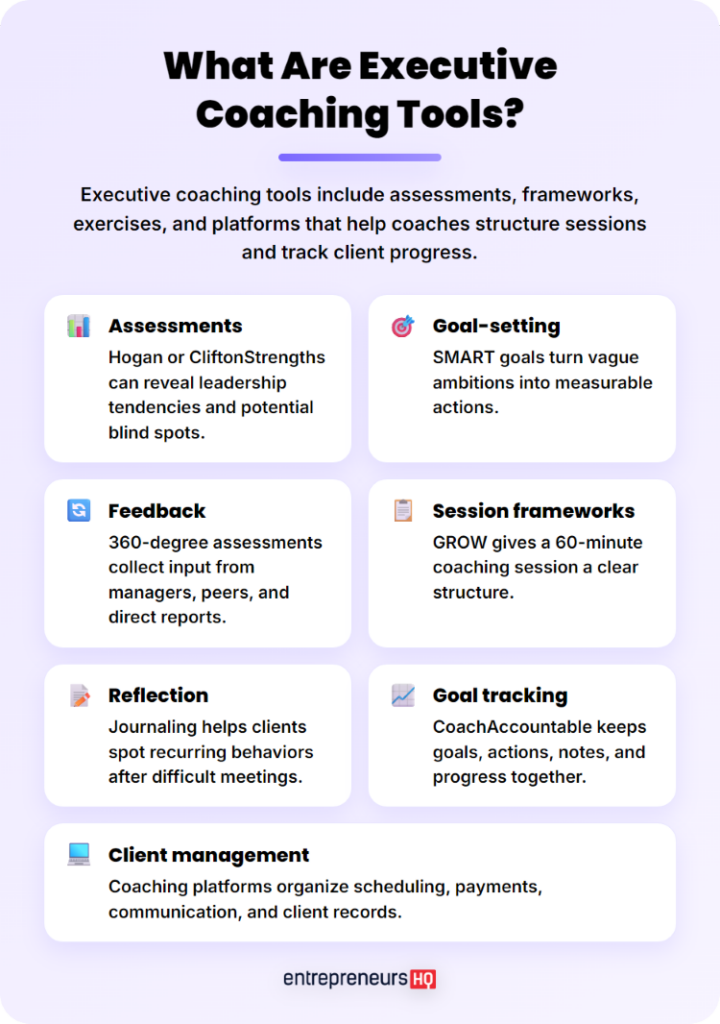
Executive coaching tools include assessments, frameworks, exercises, and platforms that help coaches structure sessions and track client progress.
- Assessments: Hogan or CliftonStrengths can reveal leadership tendencies and potential blind spots.
- Goal-setting: SMART goals turn vague ambitions into measurable actions.
- Feedback: 360-degree assessments collect input from managers, peers, and direct reports.
- Session frameworks: GROW gives a 60-minute coaching session a clear structure.
- Reflection: Journaling helps clients spot recurring behaviors after difficult meetings.
- Goal tracking: CoachAccountable keeps goals, actions, notes, and progress together.
- Client management: Coaching platforms organize scheduling, payments, communication, and client records.
Why use executive coaching tools?
Tools can make the coaching process easier to follow and give clients practical ways to apply what comes up during sessions.
- Focus conversations: Keep sessions centered on the issue that matters most that day.
- Create reflection: Give clients prompts that encourage deeper thinking after a difficult week.
- Support practice: Let clients rehearse an upcoming presentation, negotiation, or performance review.
- Document commitments: Give both coach and client a record of agreed actions.
- Maintain continuity: Help the next session pick up from the previous conversation without starting over.
Importance of using executive coaching tools
A well-chosen set of tools can strengthen the coaching experience while helping coaches manage their work more consistently as their practice grows.
- Increase consistency: Repeatable processes make it easier to deliver a reliable client experience.
- Show development: Records can reveal changes across a three-month or six-month engagement.
- Strengthen credibility: Structured methods give clients a clearer view of how coaching supports their goals.
- Save preparation time: Organized client information reduces the time spent searching through scattered notes.
- Support higher-value offers: A documented coaching process can become part of a premium leadership program.
Best Executive Coaching Tools
The best executive coaching toolkit combines frameworks for the conversation itself with assessments, resources, and systems that keep the work moving between sessions.
Below are 15 tools worth considering, with specific situations showing where each one fits.
Coaching tools examples
These coaching tools help coaches structure conversations, clarify priorities, and turn a vague leadership challenge into something a client can actually work on.
1. GROW Model
Best for: Keeping one-off coaching sessions focused and action-oriented.
The GROW Model gives coaches a simple structure for moving from a current challenge toward a specific action. It works particularly well when a client arrives with a problem but hasn’t figured out what they want from the session.
- Goal: Ask a VP of Sales what success looks like before tackling their conflict with the CRO.
- Reality: Map what actually happened during Monday’s pipeline meeting, including who said what and what happened afterward.
- Options: Have the executive generate three ways to address the recurring disagreement with their CRO.
- Will: Finish with one action, such as scheduling a 30-minute conversation before Friday.
Watch for: Clients can rush through the reflection stage when they’re eager to reach a solution.
2. SMART Goals
Best for: Turning coaching conversations into trackable development goals.
SMART goals turn broad development targets into specific commitments that can be reviewed in future sessions. They’re useful when an executive says something like “I need to become better at delegation” without defining what that means in practice.
- Specific: Delegate the weekly revenue forecast to the sales operations director.
- Measurable: Reduce the executive’s involvement from reviewing every deal to reviewing only exceptions.
- Achievable: Start with one recurring responsibility rather than handing over the entire forecasting process.
- Relevant: Connect the change to the executive’s goal of spending more time on strategic planning.
- Time-bound: Complete the transition and review results by October 31.
Watch for: A perfectly measurable goal can still be the wrong goal if it doesn’t matter to the client’s role.
3. Eisenhower Matrix
Best for: Executives struggling with prioritization, delegation, or competing demands.
The Eisenhower Matrix helps executives examine how they’re spending time across urgent and important work. A coach can use it when a client feels buried in operational tasks despite having a senior leadership role.
- Urgent and important: Handle an unexpected customer escalation threatening a major renewal.
- Important but not urgent: Block Thursday morning for the company’s 2027 strategic planning.
- Urgent but less important: Delegate routine approval requests to the operations manager.
- Neither: Remove recurring internal meetings that produce little useful output.
Watch for: A busy calendar can make everything look urgent, so discuss the business impact behind each task.
4. Wheel of Life
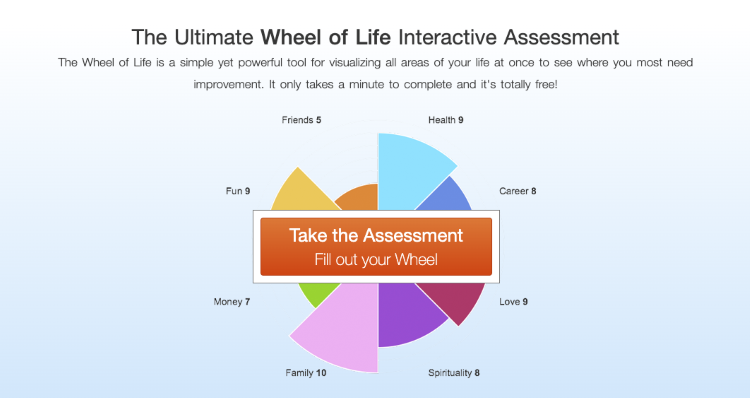
Best for: Opening broader conversations when work performance is affected by competing priorities.
The Wheel of Life gives clients a visual way to rate areas affecting their performance and satisfaction. For an executive working 60-hour weeks, it can reveal that a leadership problem is connected to pressures outside the office.
- Leadership: Rate confidence in managing the executive team from 1 to 10.
- Health: Consider how frequent 6 am flights between New York and London affect energy and concentration.
- Relationships: Examine how late-night Slack messages are affecting time with a partner or children.
- Finances: Explore pressure created by a compensation package tied heavily to company performance.
Watch for: Keep the discussion relevant to the client’s coaching goals rather than turning the session into general life advice.
Executive coaching assessment tools
Assessments give coaches structured information to work from before forming conclusions about a client’s leadership style or behavior. Use them as conversation starters and development inputs, rather than treating a score as a diagnosis.
5. Hogan Assessments
Best for: Leadership development, succession planning, and executive coaching with established organizations.
Hogan Assessments are designed for workplace personality assessment and include tools such as the Hogan Personality Inventory, Hogan Development Survey, and Motives, Values, Preferences Inventory.
- HPI: Explore everyday personality characteristics relevant to workplace behavior.
- HDS: Examine potential derailers that can emerge under pressure.
- MVPI: Identify the values and motivators influencing an executive’s work preferences.
- Executive scenario: A CTO who appears calm in normal meetings can use HDS results to explore how pressure might change their communication.
Watch for: Coaches should use the assessment within their qualifications and avoid presenting personality scores as fixed predictions.
6. CliftonStrengths
Best for: Strengths-based development, leadership conversations, and career-focused coaching.
CliftonStrengths identifies an individual’s dominant talent themes and gives coaches a useful starting point for discussing how strengths show up at work. The assessment is particularly useful when a client needs to understand how to use existing strengths more deliberately.
- Assessment: The client completes the CliftonStrengths assessment and receives their ranked talent themes.
- Strengths discussion: A client with high Strategic may explore how they approach complex business decisions.
- Leadership application: A manager with high Communication can examine how that strength affects presentations, meetings, and team updates.
- Potential overuse: A strong Achiever may explore what happens when constant productivity starts crowding out delegation.
Watch for: Strengths should be connected to observable workplace behavior rather than treated as labels.
7. Everything DiSC
Best for: Communication, collaboration, conflict, and team development.
Everything DiSC uses a behavioral model to help people understand their own communication preferences and adapt how they work with others. It can be useful when an executive’s challenge centers on communication rather than technical leadership skills.
- Self-awareness: Explore how a high-D style may approach a slow-moving decision.
- Adaptation: Practice changing communication when speaking with a detail-focused colleague.
- Team dynamics: Map differences between an executive and their direct reports before a team reset.
- Real scenario: A CEO can rehearse how to deliver the same restructuring message to a decisive CFO and a relationship-focused HR leader.
Watch for: DiSC styles describe behavioral preferences, so avoid using them to predict exactly how someone will behave.
8. The Leadership Circle Profile
Best for: Senior leadership development and deeper behavioral coaching.
The Leadership Circle Profile gives leaders feedback across creative competencies and reactive tendencies, making it useful for exploring the gap between how an executive intends to lead and how their behavior may be experienced.
- Creative competencies: Examine areas such as relational leadership, achieving, and systems awareness.
- Reactive tendencies: Explore patterns such as protecting, controlling, or complying.
- 360-degree perspective: Use feedback to compare the leader’s self-perception with responses from colleagues.
- Executive scenario: A CEO who sees themselves as highly accountable may investigate why direct reports describe their leadership as controlling.
Watch for: The value comes from discussing the feedback and choosing development priorities, not from collecting a report and filing it away.
Executive coaching resources
These resources give executive coaches credible material to recommend, reference, or build into client work.
They’re especially useful when a coaching conversation needs research, leadership examples, or a practical exercise beyond the session itself.
9. Center for Creative Leadership

Best for: Coaches who want research-backed material to supplement their own frameworks.
The Center for Creative Leadership (CCL) publishes research, assessments, articles, and leadership development resources that coaches can use to support executive development.
- Research: Use CCL research when discussing topics such as psychological safety, leading through change, or developing high-potential leaders.
- Leadership articles: Send a client a relevant CCL article before a session to give them something specific to reflect on.
- Development resources: Use its leadership material to supplement a six-month executive development engagement.
- Real scenario: A newly appointed VP can review CCL material on leading former peers before discussing their first 90 days with a coach.
Watch for: Choose resources that directly support the client’s current development goal rather than assigning reading for the sake of it.
10. Harvard Business Review
Best for: Leadership education, discussion prompts, and between-session resources.
Harvard Business Review offers articles, case studies, podcasts, and other management resources that can give coaches useful material for executive conversations.
- Case studies: Use a relevant leadership case to discuss how an executive might handle a comparable situation.
- Articles: Share a piece on delegation before a session with a CEO who still approves every minor expense.
- Podcasts: Recommend a relevant episode when an executive prefers listening during a commute from Brooklyn to Manhattan.
- Discussion prompt: Ask a client to challenge one idea from an HBR article rather than simply agreeing with it.
Watch for: HBR content can add context, but the client’s own situation should remain the focus of the coaching conversation.
Executive coaching techniques
These techniques give coaches practical ways to work through specific leadership challenges during a session.
The technique should match the problem in front of you, rather than becoming a script you force every client through.
11. Role-playing exercises
Best for: Feedback conversations, negotiations, presentations, conflict, and high-stakes meetings.
Role-playing lets an executive rehearse a difficult conversation before having it in the real world. It works particularly well when the client knows what they need to say but struggles with confidence, tone, or handling pushback.
- Performance feedback: Play the direct report while the client practices explaining why their performance needs to improve.
- Board presentation: Have the client rehearse an answer to a skeptical board member questioning a $3 million expansion.
- Difficult negotiation: Practice responding when a candidate asks for a compensation package above the approved range.
- Pressure test: Interrupt with realistic objections so the client practices staying composed instead of memorizing a perfect script.
Watch for: Keep the scenario realistic enough to expose weak spots without turning the exercise into theater.
12. Johari Window

Best for: Self-awareness, feedback, trust, and leadership behavior.
The Johari Window helps clients explore the difference between what they know about themselves, what others see, and what remains unknown. It can create useful conversations around self-awareness and feedback.
- Open area: Identify leadership behaviors the executive recognizes and colleagues also see.
- Blind spot: Compare the client’s self-view with feedback from their direct reports.
- Hidden area: Explore behaviors the executive knows about but rarely discusses with their team.
- Real scenario: A founder may realize that their habit of rewriting employees’ work is creating a level of control their team experiences as micromanagement.
Watch for: Use actual feedback and observations wherever possible instead of asking clients to speculate about what everyone thinks.
13. Feedforward
Best for: Leadership habits, communication, and behavior change.
Feedforward focuses on what a client can do differently next time, using practical suggestions instead of spending the whole conversation dissecting what already happened.
- Future behavior: Ask a CFO who struggles with difficult conversations to request two suggestions from colleagues before the next leadership meeting.
- Specific request: Have the executive ask, “What could I do differently to make my message clearer?”
- Action: Turn the suggestions into one behavior to practice during the following week.
Watch for: Keep suggestions specific and actionable rather than collecting vague advice.
14. Appreciative Inquiry
Best for: Strengths-based coaching, leadership development, and rebuilding confidence.
Appreciative Inquiry helps clients examine moments when they performed at their best and identify what made those situations work.
- Peak experience: Ask a regional director to describe the strongest team turnaround they’ve led.
- Explore success: Identify the decisions, behaviors, and conditions that contributed to the result.
- Transfer: Look for ways to apply those same behaviors to a current team struggling with accountability.
Watch for: Don’t gloss over genuine problems; use successful experiences to find useful behaviors the client can repeat.
15. Active Listening
Best for: Building trust, uncovering underlying concerns, and helping clients think more clearly.
Active listening gives the coach a way to slow the conversation down and understand what the client means before jumping toward advice or solutions.
- Reflect: Repeat the key point in your own words when an executive describes tension with a co-founder.
- Clarify: Ask what the client means by “my team doesn’t respect me” before treating it as a settled fact.
- Notice: Pay attention to changes in tone, hesitation, or repeated phrases that may point to something worth exploring.
- Summarize: Reflect the main points back before moving toward an action or decision.
Watch for: Listening should create space for the client to think, not become a scripted series of reflective questions.
How To Prepare For Executive Coaching Sessions

Prepare by bringing one real leadership situation, the outcome you want, and evidence from the past week. Before each session, review your commitments and identify where you felt stuck, reactive, or effective.
- Review commitments: Check whether the VP you coached last Thursday delegated the weekly revenue meeting to their sales director as planned.
- Choose a live challenge: Bring the specific board meeting, difficult employee conversation, or hiring decision that’s creating pressure this week.
- Gather evidence: Note what happened, who was involved, what was said, and what happened next, rather than relying on a vague “the meeting went badly.”
- Define the desired outcome: Decide if the session needs to produce a decision, a rehearsal, a new behavior, or a concrete action.
- Name the pattern: Look for recurring behaviors, such as avoiding conflict with a strong-willed CFO or rewriting every presentation instead of delegating.
- Prepare candidly: Tell your coach what actually happened, including the part where you lost your temper in Monday’s leadership meeting.
5 Executive coaching examples to study
Studying established coaches can show you how different coaching businesses position their expertise, structure their offers, and communicate their value to get coaching clients.
These examples cover business coaching alongside more traditional executive and leadership coaching models.
- Liam Austin: Study how he combines coaching, high-ticket offers, virtual events, and client acquisition into a business model built for coaches, consultants, speakers, and experts.
- Marshall Goldsmith: Study his executive and leadership coaching work with senior leaders and his focus on measurable behavioral change.
- Michael Bungay Stanier: Study how he turns simple coaching questions and conversation frameworks into a clear, recognizable coaching methodology.
- Nancy Kline: Study how her Thinking Environment approach gives coaches a distinct methodology centered on attention, thinking, and better conversations.
- Paddy Gower: Study how a more specialized executive coaching position can focus on leadership communication, executive presence, and performance at senior levels.
Basic executive coaching toolkit must-haves
You can start with a small toolkit and add specialized resources as your practice grows:
☐ Client intake form: Capture the executive’s role, goals, challenges, expectations, and priorities before the first session.
☐ Assessment tool: Use a validated assessment when personality, leadership behavior, or workplace patterns need closer examination.
☐ Session framework: Keep a repeatable structure for opening the conversation, exploring the issue, and agreeing on next steps.
☐ Goal tracker: Record objectives, deadlines, milestones, and progress throughout the coaching engagement.
☐ Session notes: Document key observations, client commitments, and follow-up points while protecting sensitive information.
☐ Feedback system: Collect perspectives from managers, peers, or direct reports when outside input would strengthen the coaching work.
☐ Scheduling and payment system: Automate bookings, reminders, invoices, and payments so administrative tasks don’t consume coaching time.
☐ Client resource library: Keep relevant worksheets, exercises, reading materials, and preparation guides ready to share when needed.
How To Grow Your Practice With Executive Coaching Tools
Use this checklist to build a coaching toolkit that improves delivery, reduces admin, and motivation assessment scales with your client load:
- Define the outcome: Name the measurable result you support, such as faster delegation, clearer executive communication, or stronger team leadership.
- Map the workflow: Document every step from inquiry, intake, scheduling, assessment, and sessions through payment, progress reviews, and follow-up with the help of AI tools for coaches.
- Locate the bottleneck: Identify the step consuming the most time, creating the most errors, or causing the most client friction.
- Solve one problem: Choose a tool for that bottleneck rather than adding software for its popularity or feature list.
- Template repeatable work: Standardize intake forms, session agendas, goal reviews, progress updates, and follow-up messages.
- Connect core systems: Link scheduling, payments, notes, assessments, and communication to prevent duplicate data entry.
- Test with a few clients: Confirm the tool makes participation, communication, or accountability easier before rolling it out broadly.
- Measure the change: Track time saved, admin reduced, completion rates, and client engagement before and after implementation.
- Remove low-value tools: Eliminate subscriptions that add maintenance without improving coaching delivery or client outcomes.
- Check scalability: Verify that the system supports more clients without multiplying manual tasks across every engagement.
5 Key factors to consider while choosing tools for executive methods
Before paying for another subscription, check five things:
- Client fit: Does the tool suit the executives, industries, and leadership challenges you actually coach?
- Ease of use: Can a busy VP complete the assessment or update their goals without needing a tutorial?
- Useful outputs: Will the results give you something meaningful to discuss, measure, or act on?
- Workflow fit: Can it slot into your existing process without creating extra admin?
- Cost and scalability: Does the price make sense now, and will it still work when you have 10, 25, or 50 clients?
Everything You’ll Need For Them Succeed
The best executive coaching tools should make your coaching easier to deliver and easier for clients to act on.
Start with a few tools that fit your process. Use assessments to uncover useful patterns, frameworks to keep sessions focused, and tracking systems to make progress visible. As your client list grows, add the systems that save you time and make your coaching business easier to run.
The bigger opportunity comes when your coaching process is strong enough to support a high-ticket offer.
If you want help turning your expertise into an offer that attracts high-paying clients, our Highly-Paid Coach system shows you how we build the offer, help you enroll 3-5 clients in a few weeks, and set up a system you can keep using as your coaching business grows.
See how the Highly-Paid Coach system works for free.