Some careers you choose. This one tends to choose you.
If you’ve walked the road of recovery or watched someone you love fight their way back, you already know what most people don’t…
And that the hardest part about getting sober is feeling like no one around you truly gets it.
Peer recovery coaches exist to close that gap.
And yes, it’s truly deeply meaningful work. But meaningful work still needs to pay. You deserve to know exactly what this career looks like financially before you commit.
Inside you’ll see the full breakdown on hourly rates, annual salaries, the earning potential, and where in the country this work is valued most.
Here’s your clear, honest look at the latest peer recovery coach salary figures and how to make sure you’re earning what you’re worth in an industry that exists to turn people’s lives around.
Peer Recovery Coach Salary (Quick Numbers at a Glance)
These are the ZipRecruiter salary estimates and figures worth bookmarking before you step fully into your peer recovery coach role.
Whether you’re exploring this career for the first time or trying to figure out if you’re being paid what you’re honestly worth, these numbers give you a clear starting point.
- Average hourly rate: $19.50 per hour
- Average weekly pay: $779 per week
- Average monthly pay: $3,379 per month
- Average annual salary: $40,551 per year
- Entry level (25th percentile): $34,000 per year/$13.22 per hour
- Upper range (75th percentile): $44,500 per year/$25.24 per hour
- Top earners (90th percentile): $51,000 per year
- Highest reported salary: $52,500 per year
- Highest paying city: Nome, AK at $50,303 per year/$24.18 per hour
What Is a Peer Recovery Coach?

A peer recovery coach is someone who has lived through addiction or mental health challenges and now uses that experience to support others going through the same thing.
That last part matters because this job isn’t anything like a therapist or a counsellor working from a textbook.
A peer recovery coach brings something clinical training can’t teach: the credibility of having actually been there.
That lived experience is the whole foundation of the role. It’s what builds trust with people who are often sceptical of formal support systems and it’s what makes peer recovery coaching genuinely effective.
What does a peer recovery coach do?

Day to day, a peer recovery coach works alongside people in recovery to help them stay on track, rebuild their lives, and figure out what comes next.
That can look like:
- Navigating treatment options: Helping someone find and access the right support services.
- Providing accountability: Showing up consistently between appointments to keep their progress moving.
- Tackling practical challenges: Supporting with real-life hurdles like housing, employment, or rebuilding family relationships.
- Sharing their story: Using lived experience to reduce shame and build genuine hope.
- Being a steady presence: Offering trust and consistency during one of the most unstable periods of a person’s life.
How Much Does a Peer Recovery Coach Make?
Considering location and salary matters just as much as what you do. Here’s how peer recovery coach salaries break down across the most common employer types:
- Hospitals and healthcare systems: Typically the highest-paying employed setting, with coaches earning toward the upper end of the $40,000 to $52,500 range plus benefits and potential advancement.
- Government agencies and public health programs: Offer stable, salaried positions that often include benefits and a pension, usually sitting close to or above the $40,551 national average.
- Nonprofit organizations: The most common entry point for new coaches, with salaries that typically range between $34,000 and $40,000 depending on funding and location.
- Community health centers: Similar to nonprofits in pay range, though some federally qualified health centers offer slightly better compensation packages.
- Private practice and independent coaching: No ceiling for the salary for a peer recovery coach and the possibility of a lower cost of living, but the average salary for these top performers depends entirely on how they price and fill their client roster.
Peer recovery coach pay rate
You’ve got options here and knowing all of them changes how you think about this career’s life coach pay rate entirely.
- $13.22 to $25.24 per hour: Standard range for employed coaches working in treatment centers, nonprofits, or government agencies.
- $50 to $150 per hour: Typical range for coaches offering private one-on-one sessions independently.
- $500 to $3,000 per package: 6 to 12 week private coaching programs bundling sessions, accountability, and structured support.
- $50 to $200 per month: Group coaching or peer support programs with ongoing access from January to December.
- $1,000 to $5,000 per month: Some recovery coach jobs pay per hour or through retainer arrangements for coach jobs in the US contracted by organizations or EAPs.
Peer Recovery Coach Salary (Complete Breakdown)
The salary range for peer recovery coaches is wider than you might expect. Where you fit within it comes down to your location, experience, employer type, and how you’ve positioned yourself in the field.
| Hourly | Monthly | Yearly | |
| Low (25th percentile) | $13.22 | $2,300 | $27,500 |
| Average | $19.50 | $3,379 | $40,551 |
| High (75th percentile) | $25.24 | $4,400 | $44,500 |
| Top earners (90th percentile) | – | – | $51,000 |
| Maximum reported | – | – | $52,500 |
Peer recovery coach salary per hour
The average peer recovery coach earns $19.50 per hour in the United States. This is how that breaks down across the pay spectrum:
- Bottom of the range: $13.22 per hour, representing the lower end of reported wages.
- Average hourly rate: $19.50 per hour, which is the national average as of May 2, 2026.
- Upper range: $25.24 per hour for coaches in higher-paying roles or locations.
- What makes a difference: Location, employer type, certifications, and specialization all play a role in where your hourly rate falls.
Peer recovery coach salary per month
Based on the national average hourly rate, the typical peer recovery coach takes home around $3,379 per month. Here is the full monthly range:
- Low end: Around $2,300 per month for entry-level or lower-paying regional roles.
- Average: $3,379 per month based on the $19.50 hourly national average.
- Upper range: Around $4,400 per month for coaches in higher-paying positions or cities.
- Weekly equivalent: The average works out to approximately $779 per week.
Peer recovery coach salary per year
The average annual peer recovery coach salary in the United States is $40,551. Here is what the full range looks like:
- Lowest reported: $27,500 per year
- 25th percentile: $34,000 per year
- Average: $40,551 per year
- 75th percentile: $44,500 per year
- 90th percentile (top earners): $51,000 per year
- Highest reported: $52,500 per year
The gap between the lowest and highest reported salaries is $25,000, which tells you there is real room to grow in this career depending on the choices you make.
What are the top highest paying cities for peer recovery coach jobs?
Location has a significant impact on what you earn as a peer recovery coach. These are the top 10 highest paying cities that offer above the national average of $40,551, with some coming in nearly 24% higher.
| City | Annual Salary | Hourly Wage |
| Nome, AK | $50,303 | $24.18 |
| Berkeley, CA | $49,652 | $23.87 |
| Angwin, CA | $49,621 | $23.86 |
| Sitka, AK | $48,851 | $23.49 |
| Everett, WA | $48,799 | $23.46 |
| San Francisco, CA | $47,776 | $22.97 |
| Santa Clara, CA | $47,624 | $22.90 |
| Sunnyvale, CA | $47,593 | $22.88 |
| Livermore, CA | $47,566 | $22.87 |
| San Jose, CA | $47,525 | $22.85 |
Nome, AK tops the list at $50,303 per year, coming in $9,752 above the national average. Angwin, CA sits close behind, beating the national average by $9,070.
It is worth noting that the difference in salary for these top 10 cities varies very little at 5% so lower cost of living may matter more than the salary figure itself when weighing up a move.
How Much Can a Peer Recovery Coach Make?
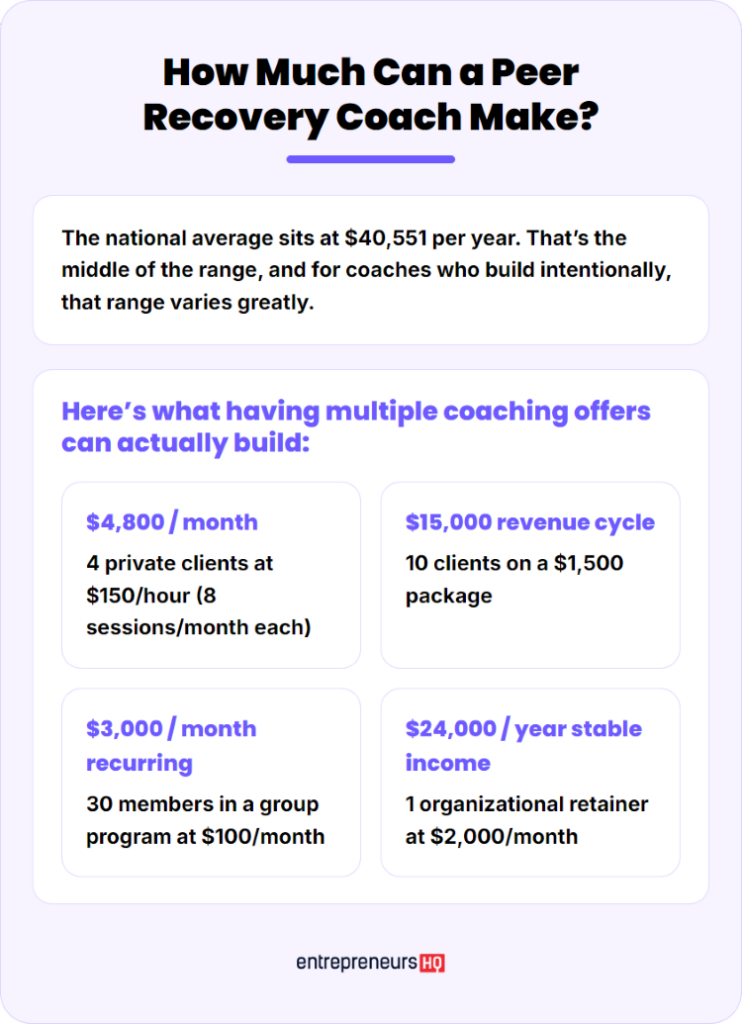
The national average sits at $40,551 per year. That’s the middle of the range, and for coaches who build intentionally, that range varies greatly.
Here’s what having multiple coaching offers can actually build:
- 4 private clients at $150/hour (8 sessions/month each): $4,800/month
- 10 clients on a $1,500 package: $15,000 revenue cycle
- 30 members in a group program at $100/month: $3,000/month recurring
- 1 organizational retainer at $2,000/month: $24,000/year in stable income
Employed roles give you stability. Your own practice gives you a ceiling worth chasing.
6 Factors that impact how much peer recovery coaches make

Income in this field is movable. These are the six things that get it going the fastest and the most often:
- Pricing structure: Hourly rates cap your income fast. Packages and programs change that equation entirely.
- Certification level: Recognized credentials like CPRSS directly influence what employers pay and what private clients trust you to charge.
- Specialization: Coaches who work with specific populations, such as veterans or adolescents access higher-paying roles and contracts.
- Offer structure: One-on-one sessions only go so far. Group programs and digital offers are where income starts to scale.
- Visibility and reputation: Coaches with documented results, testimonials, and an audience do not rely on inconsistent referrals to fill their client roster.
- Location and setup: Employed salaries vary significantly by state, but coaches running online practices reduce that limitation considerably.
How to Make Money as a Peer Recovery Coach

Most peer recovery coaches earn from more than one source. Here are the most common ways to bring in income in this field.
- Work for a treatment center or hospital: Many healthcare organizations employ peer recovery coaches directly, offering stable hourly pay, benefits, and a built-in caseload.
- Join a community health program: Nonprofits, government agencies, and community organizations regularly hire peer coaches to support local recovery efforts.
- Contract with managed care organizations: Some coaches work independently under contract with insurance or managed care providers, giving more flexibility over hours and clients.
- Offer private coaching services: Working one-on-one with clients outside of a formal employer structure allows you to set your own rates and build a practice around your strengths.
- Support employee assistance programs (EAPs): Companies with EAP partnerships sometimes bring in peer coaches to support employees dealing with addiction or mental health challenges.
- Speak, train, or consult: Coaches with strong lived experience and communication skills can earn additional income through workshops, staff training, and public speaking.
How to increase your peer recovery coach earnings

Your starting salary is rarely your ceiling, and most coaches who earn well have made deliberate moves to get there.
Here’s where to focus when looking at the latest histogram of peer coach salary ranges:
- Podcast guesting: Show up on recovery or coaching podcasts, share your story, and let the audience come to you. It’s one of the lowest-effort, highest-trust ways to attract clients.
- Get certified: Holding a recognized peer recovery coach certification like CPRSS or CRPS signals credibility to employers and justifies higher life coach earnings.
- Specialize in a high-demand area: Coaches who focus on specific populations such as veterans, adolescents, or co-occurring disorders often command better rates.
- Pursue additional qualifications: Adding mental health first aid, motivational interviewing, or case management training to your toolkit makes you more valuable across more settings.
- Move into supervision or training roles: Senior peer coaches who train and oversee others typically earn significantly more than frontline roles.
- Relocate or work remotely for higher-paying states: Salaries vary widely by state, and working for an employer based in a higher-paying region, even remotely, can make a real difference.
- Build a private practice: Transitioning away from hourly employment toward a coaching practice with recurring clients gives you more control over your income ceiling.
Check out my full guide on how to price your coaching packages so you start off strong.
How to Become a Peer Recovery Coach
The barrier to entry is lower than most helping professions, but that does not mean there is nothing required. Here is the path most coaches follow:
- Meet the lived experience requirement: Most certification bodies and employers require you to be in stable, long-term recovery yourself, typically a minimum of one to two years.
- Complete a state-approved training program: Most states have specific peer support training requirements, usually ranging from 40 to 70 hours, that you will need to complete before applying for certification.
- Get certified: Look into certifications like the Certified Peer Recovery Support Specialist (CPRSS) or your state’s equivalent, as requirements vary but typically include training hours, a supervised practicum, and an exam.
- Apply for entry-level roles: Treatment centers, nonprofits, and community health organizations are the most common starting points, and many will hire newly certified coaches and provide on-the-job experience.
- Log supervised hours: Some certifications and higher-level roles require documented hours working under a qualified supervisor, so keep track from day one
- Keep learning: The coaches who grow fastest treat this as a profession. Continuing education, peer networks, and mentorship all help to speed up your progress.
The Whole Point Is To Not Do It Alone
You already know the peer recovery coach salary range, the cities that pay the most, and what it takes to push your earnings higher.
But the coaches who actually get there don’t figure it out on their own.
They get clear on their niche. They build offers that work. They find a system that brings in clients consistently so they’re not starting from scratch every month.
That’s exactly what I help coaches do at EHQ.
If you’re serious about turning your experience into a coaching practice that pays you what you’re worth, the next step is finding out how to build it properly.
My 3-Step Highly Paid Coach Blueprint walks you through the exact system coaches are using right now to build high-ticket irresistible coaching offers, attract the right clients, and create income that doesn’t depend on clocking in every day.
Your lived experience is already the credential. Let’s build the business around it.
Access the Highly-Paid Coach Blueprint now.